
How Long Does It Take to Learn Piano? A Realistic Beginner’s Guide

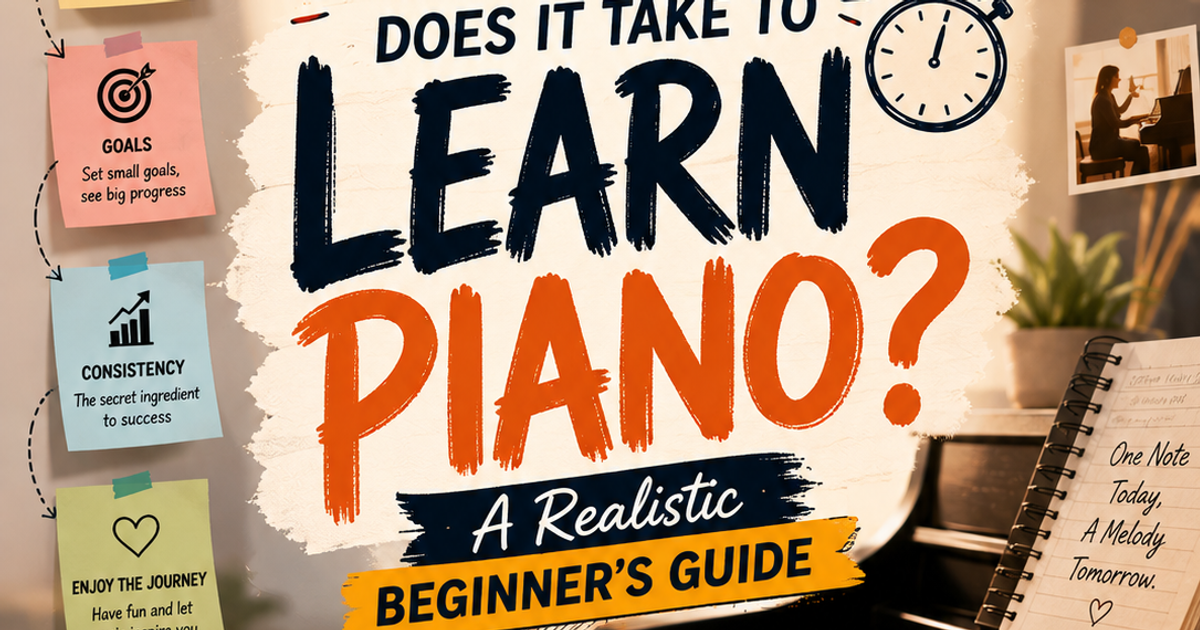
“How long does it take to learn piano?” If you're searching for piano lessons online, chances are you want more than the usual “it depends.” You want to know when you'll actually be able to play a song, use both hands, read music, or sit at a piano and play without constantly stopping.
The good news? You can start playing simple piano melodies within your first month. With consistent practice, many beginners can play complete beginner songs within three to six months. Becoming a confident recreational pianist can take around one to two years, while advanced and professional playing is a much longer journey.
The timeline depends on your goal, practice routine, previous musical experience and the quality of your instruction.
Quick Answer: How Long Does It Take to Learn Piano?
For most beginners:
- 1 month: Basic notes, rhythm, posture and simple melodies
- 3 months: Both-hand coordination, basic scales and beginner songs
- 6 months: Complete songs, chords, dynamics and basic music theory
- 1-2 years: Confident recreational playing and broader repertoire
- Several years: Advanced performance, improvisation and professional-level musicianship
These are realistic milestones, not guarantees. Some learners progress faster; others need more time.
What Does It Actually Mean to Learn Piano?
Learning piano isn't simply memorising songs. A well-rounded piano course for beginners develops several skills at once: keyboard familiarity, finger coordination, rhythm, music reading, scales, chords, ear training and musical expression.
Someone who can play Twinkle Twinkle Little Star has started learning piano. A pianist who can read music, accompany another singer, improvise and perform different styles has developed a much broader skill set.
That's why “how long does it take to learn piano?” doesn't have one universal answer.
Piano Learning Timeline: What Can You Expect?
Month 1: Learn the Piano Basics
Your first month should focus on building a strong foundation rather than rushing into difficult songs.
You'll typically work on:
- Correct sitting posture and hand position
- Finger numbers and keyboard layout
- Basic rhythm and note values
- Simple one-hand melodies
- Five-finger exercises
- Identifying notes on the keyboard
By the end of the first month, a beginner should aim to recognise basic notes, maintain a simple rhythm and play a few familiar melodies.
Month 2: Start Reading Music
Once you're comfortable with the keyboard, you can begin connecting written music to the notes you're playing.
This stage introduces the Grand Staff, treble clef, bass clef and Middle C, alongside simple sight-reading exercises.
This is where structured piano training online can make a real difference. Instead of memorising where notes sit, you're gradually learning how to understand music itself.
Month 3: Play With Both Hands
Three months is often an exciting point for beginners because the piano starts feeling less like an unfamiliar instrument.
You can begin working on:
- Both-hand coordination
- Basic accompaniment patterns
- C, G and F major scales
- More varied rhythms
- Simple complete songs
This is also a good stage to start learning beginner-friendly Bollywood or contemporary songs if that's what motivates you.
Month 4: Learn Scales, Chords and Theory
Now you're moving beyond simply playing notes.
You'll begin understanding how chords are built, how major and minor sounds differ, and how scales connect to songs.
Basic triads and common chord progressions can also help you accompany singers or create simple arrangements.
Month 5: Build Your Repertoire
By the fifth month, practice can become more musical and less exercise-focused.
You can start combining technique with:
- Beginner classical pieces
- Pop songs
- Bollywood songs
- Chord accompaniment
- Sight-reading
- Performance practice
This is often when learners realise that learning piano isn't just about completing exercises, it's about being able to make music with them.
Month 6: Play With More Expression
Around six months of consistent learning, many beginners can start focusing on dynamics, articulation and phrasing rather than simply hitting the correct notes.
You may also be ready to explore formal examination preparation. ChordsCraft's programmes include pathways involving Trinity and ABRSM, alongside RSL and MTB certification options.
How Much Should You Practice Piano Every Day?
You don't need to practise for hours every day.
For beginners, 20-30 minutes of focused daily practice can be a practical starting point. Adults with more available time may work towards 30-45 minutes, while intermediate learners can gradually increase their practice duration.
A simple 30-minute routine could look like:
Practice -
Finger exercises - 5 minutes
Scales - 5 minutes
Sight-reading & rhythm - 5 minutes
Song/repertoire - 10 minutes
Review & free playing - 5 minutes
Consistency beats cramming. Thirty focused minutes several days a week is generally more useful for building a habit than one long practice session followed by several days away from the keyboard.
Can Adults Learn Piano?
Absolutely. You are not too old to learn piano.
Adults often bring useful advantages to music learning, including clearer goals, stronger concentration and an understanding of how they prefer to learn.
The biggest challenge is usually not age - it's finding a sustainable practice schedule.
If you're balancing work, studies or family responsibilities, online piano classes can remove some of the friction associated with travelling to a physical music school.
ChordsCraft offers online music learning for different age groups and skill levels, with flexible timings and personalised instruction.
Is It Better to Learn Piano Online or By Yourself?
You can certainly start learning piano through apps, videos and free online resources.
But there's a difference between learning information and learning technique.
A teacher can identify issues with posture, fingering, rhythm or hand coordination before they become habits. Structured piano lessons online can also give you a progression instead of leaving you to decide what to learn next.
For beginners who want personalised guidance, ChordsCraft provides 1-to-1 online music lessons rather than relying solely on self-paced material.
What Can Help You Learn Piano Faster?
The most useful tools aren't necessarily complicated.
A suitable keyboard or piano, metronome, beginner sheet music, practice journal and structured lessons can give you a strong foundation.
You can also make practice more engaging by learning songs you genuinely enjoy. ChordsCraft even provides a music-learning games section with piano and guitar modes, including quiz and free-play options.
That kind of active practice can make learning feel less like homework and more like actually making music.
How Long Does It Take to Learn Piano Well?
If by “learn piano” you mean play a few songs, you could reach that milestone within a few months.
If you mean read music comfortably, play with both hands, understand chords and scales, accompany others and perform confidently, expect a longer process.
And if your goal is advanced classical performance or professional musicianship, think in terms of years rather than months.
There is no final level where piano suddenly becomes “finished.” Even experienced pianists continue improving technique, interpretation and musical expression.
Start Your Piano Journey
You don't need to wait until you have more time, better coordination or a “natural” talent for music. Start with the basics, practise consistently and let your ability grow one milestone at a time.
If you're ready to move from watching piano tutorials to actually learning with a structured programme, explore ChordsCraft's music courses and find a learning path suited to your goals.
And if you'd rather experience the teaching approach first, you can book a free trial class and take the first step from “I want to learn piano” to “I can actually play.”
Because learning piano isn't about how quickly you reach the finish line. It's about how much music you can make along the way.
Related Music Courses
Classical & Modern Piano
Learn piano with graded ABRSM/Trinity curriculums from certified instructors.

Debojoti De is a pianist, music educator, and the founder of ChordsCraft Institute of Music. He has been playing the piano for over 10 years and has taught 100+ students through personalized online lessons. His expertise includes beginner piano education, music theory, keyboard selection, and exam preparation for internationally recognized curricula such as Trinity and ABRSM. As one of the Top 5 Indian Piano Teachers on Superprof, Debojoti combines practical teaching experience with in-depth research to create trusted buying guides, piano tutorials, and educational resources. Through his articles, he helps aspiring musicians choose the right instruments, develop effective practice habits, and build a strong musical foundation.
Frequently Asked Questions
Start Your Musical Journey Today
Experience 1-on-1 personalized lessons with certified music and dance instructors. Pick your instrument, choose your schedule, and get structured guidance.
Recommended Reading
 🎹Piano
Best Online Piano Lessons: How to Choose the Right Course
Looking for the best online piano lessons? Learn how to choose the right piano course based on live 1-to-1 instruction, teacher expertise, lesson structure, practice support, flexibility and trial classes—so you can learn piano confidently from home.
 🎹Piano
ABRSM or Trinity? What We Tell Parents After Preparing 250+ Students for Both
ABRSM or Trinity? Real advice from teachers who've prepared 250+ students for both exam boards. Find the right fit for your child's strengths.
 🎹Piano
Best Keyboard for Beginners in 2026: The Complete Buyer's Guide to Choosing the Right Keyboard
Looking for the best keyboard for beginners in 2026? Compare top models, features, prices, and expert buying advice from ChordsCraft Institute of Music.